we are iterations
The Creative Evolution of Identity

One of our most comforting myths is the idea of a central self, a single, stable “me” sitting at the core of experience, directing thoughts and movements through the world.
This feels obvious because consciousness appears unified.
But when we look closely, that unity starts to fragment.
In reality, we are multiple and responsive.
This is where the idea of iteration matters.
We utter who we think we are, mostly internally, to confirm a reliable feeling of center to ourselves.
These iterations hold us together not because we are singular, but because we repeat, reform again and again from familiar patterns.
The feeling of a center comes after the fact, as a story we tell to explain coherence that emerged on its own.
The myth persists because it’s useful. A central self makes responsibility, continuity, and identity easier to manage.
It lets us say “this is who I am” instead of “this is how I’m composed right now.”
Neuroscience, psychology, and philosophy all point in the same direction: there is no single place where “you” live.
What we call the “self” functions less as a commander and more as a moment by moment convergence.
We are all a temporary arrangement, converging in a dynamic relationship with the world.
The Self: An Ongoing Collaboration
When we talk about freedom from the self, I think we are longing for relief from rigidity, not from selfhood.
The idea of a final and complete self creates expectations we will never be able to fulfill.
Each moment of selfhood is a version, not a final release.
There’s no endpoint where you fully “become yourself.”
Old traits return, new ones emerge, some fall away.
Creativity doesn’t just happen within the self; creativity is how the self keeps forming at all.
We are what Dr. Vandana Shiva calls, “generative organisms”, inherently creative, self-organizing, and a part of nature.
Creativity is our way of answering back in collaboration with all things, rather than through interference.
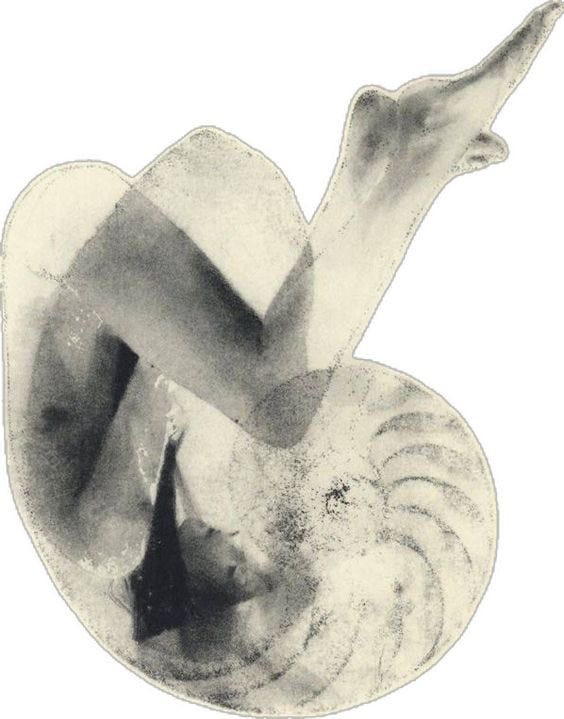
Creative Organisms
Creativity reveals that the self is not a fixed identity, but rather a moving ecology.
A living system of selves that take turns leading.
The brain doesn’t consult a CEO; it negotiates.
What feels like authorship is often a narration of what has already happened.
There’s a question I’ve been coming back to over and over:
How is it to be an environment that registers the world as it is?
The answers and stability we seek are not the absence of change, but the result of cycles that return often enough to feel solid.
Four Phases of Touching the World as It Is
Observation : Creativity begins in noticing; observation is never neutral, even the noticing is selective. If we can stay here long enough, we watch ideas form and meaning arise.
Meaning-making : The process that allows us to interpret experiences and create narratives that make life feel coherent. Here we weave stories out of the flux of perception and memory.
Expression : The only external part of the cycle where we take action, communicate and touch the world. Expression reveals selfhood, our iterative selves are otherwise invisible.
Integration : This is where we create continuity amidst change. Without claiming permanence or finality, our selves become a working whole. What we integrate becomes the ground from which future work grows.
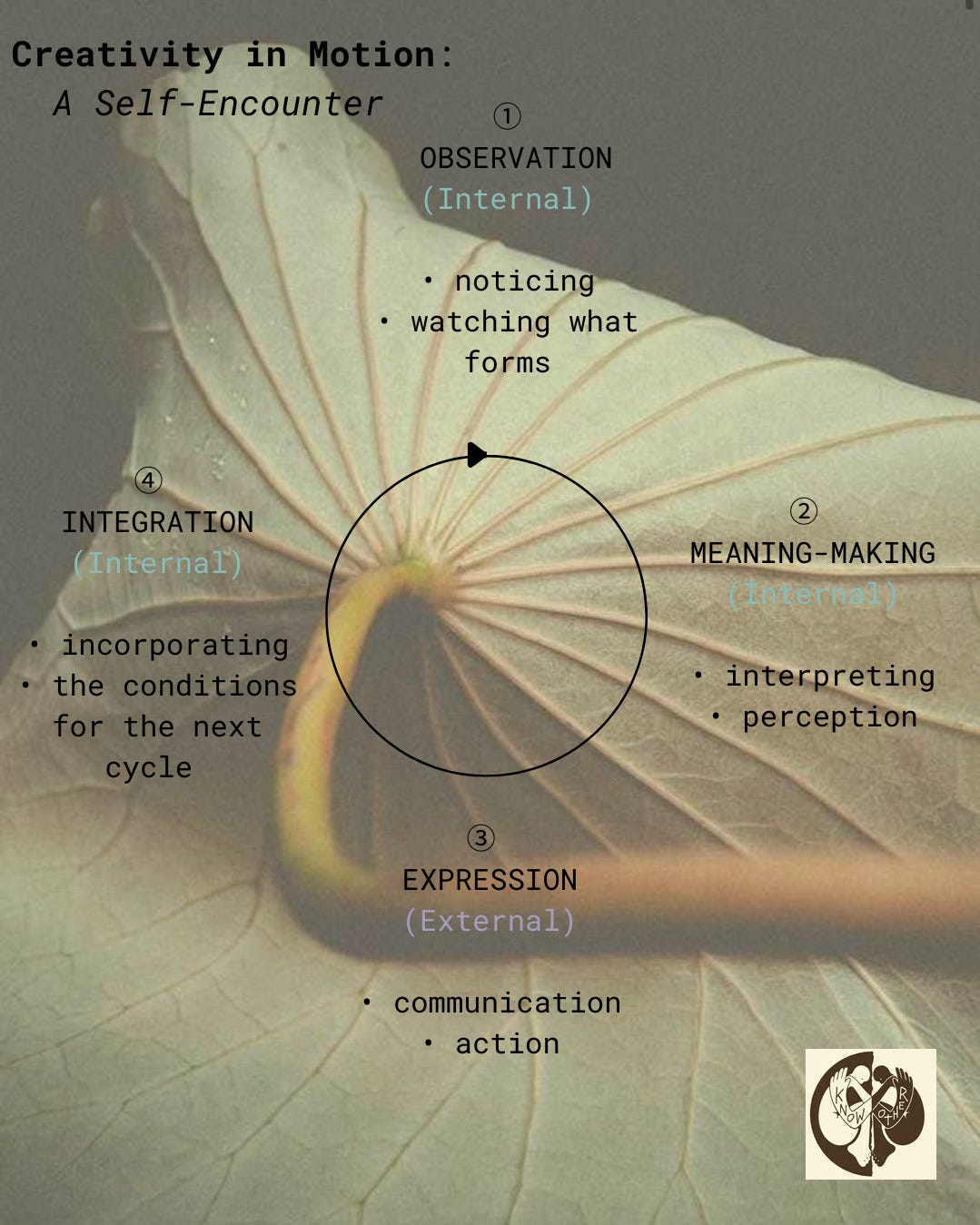
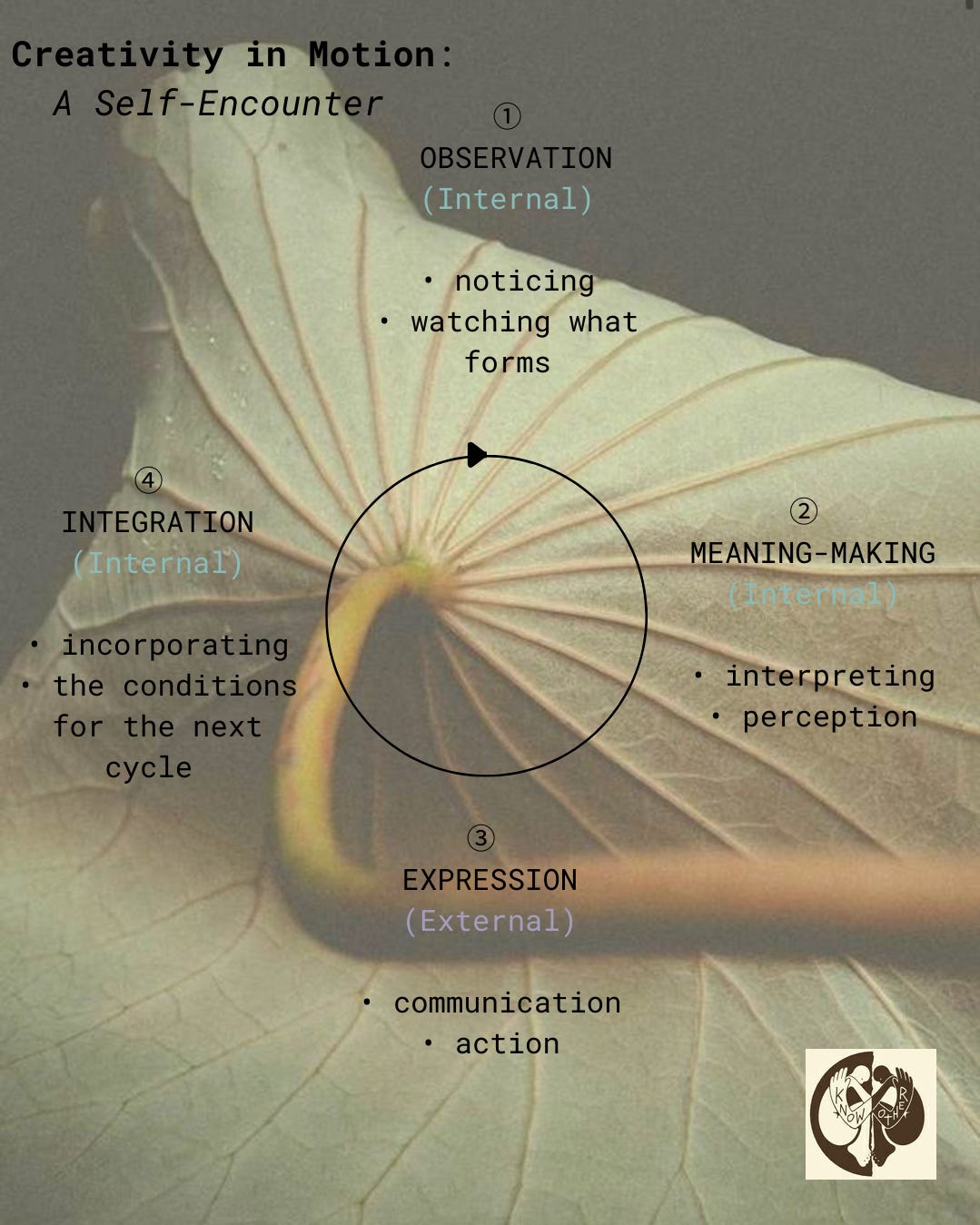
These four phases: observation, meaning-making, expression, and integration loop continuously.
Each cycle compounds the next.
Previous forms break down and become nourishment.
Our past expressions aren’t killed, they’re composted.
What we create becomes a more honest interpretation of making contact with the world.
What we become is a more spacious structure, capable of carrying greater truth, compassion, and complexity;
And spaciousness comes not from destroying the selves within us, a kind of self-directed violence, but from letting them move, exchange places, and be malleable.
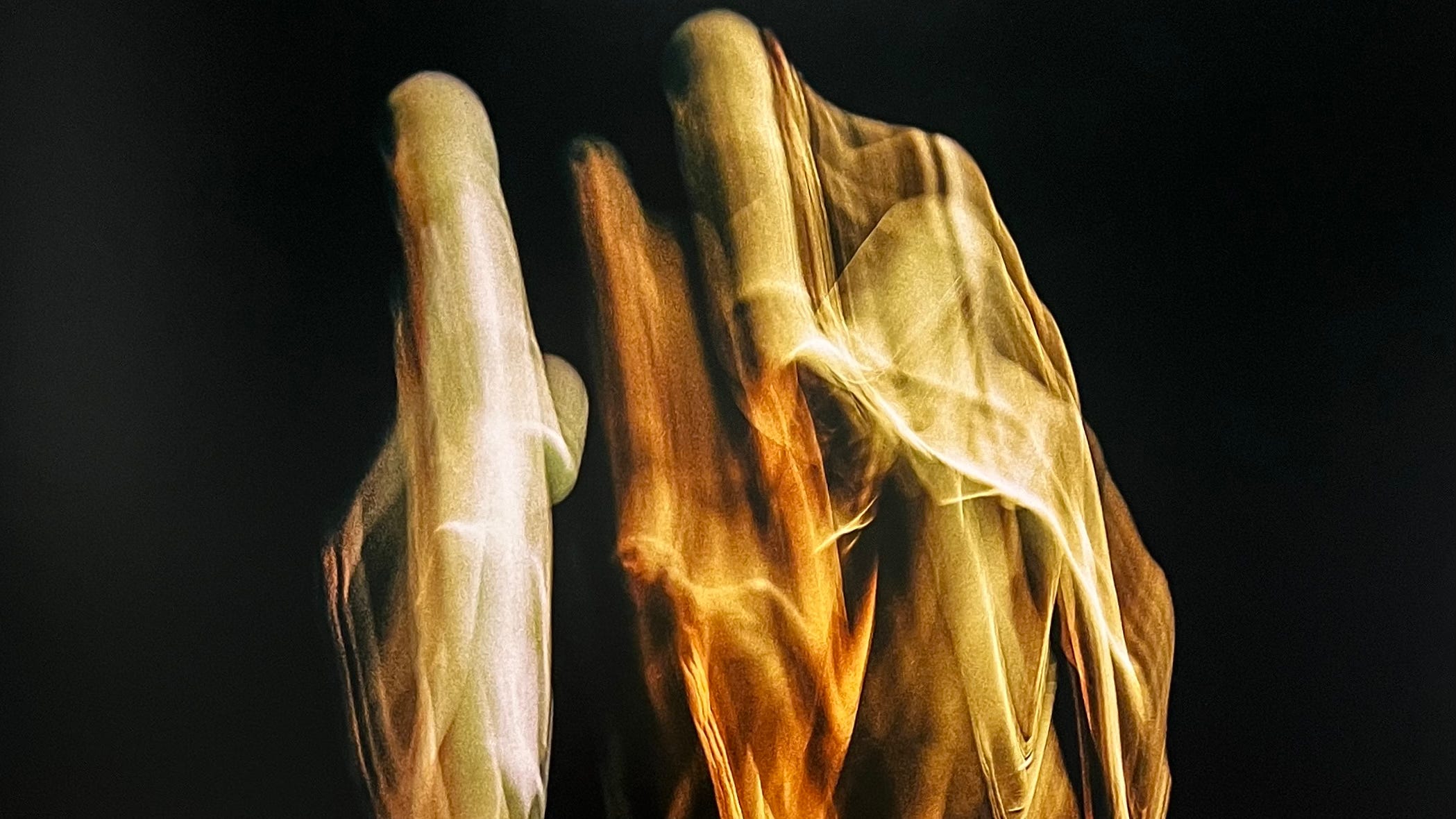
Is there anything at the center?
Creative growth isn’t a straight line; it’s a closed loop.
It’s our cyclical creative evolution.
Each turn brings us back to the beginning but with more nuance, depth, and trust in the process itself.
It’s a self-encounter.
Letting go of the central self isn’t a loss.
It’s a release from the pressure to be consistent, complete, or finished.
If there is no core to constantly compare ourselves to, there is room to evolve.
You don’t have to “find yourself.” You are already doing what you’ve always done: iterating.
And that may be the peaceful truth behind all the noise.
Not that the self is splintered or fragmented,
but that it was never meant to be singular in the first place.
Each version of ourselves is a step into a river that has already moved on.